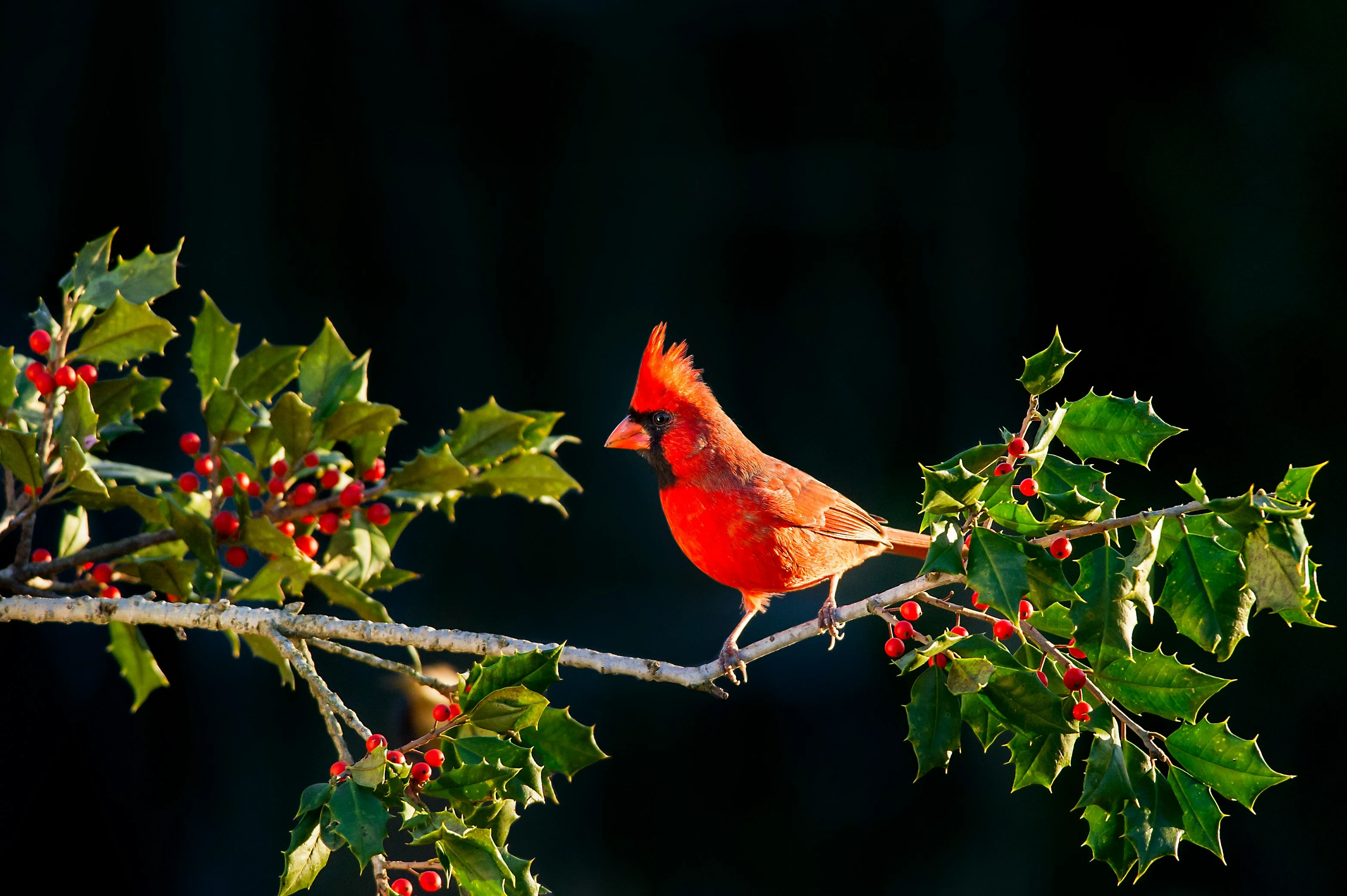
Northern Cardinal identification sounds like it should be effortless, the male is about as recognizable as backyard birds get, but the female and juvenile trip up a lot of beginners who assume a plain brown bird with a crest can't possibly be the same species. This is one of the most iconic feeder birds in eastern Canada, and once you know what to look for beyond just "red bird," picking out every age and sex becomes easy.
Identification
Size: 21 to 23 cm long, noticeably larger and chunkier than a sparrow or finch, with a prominent pointed crest on the head at all times.
Adult male: Unmistakable. All-over brilliant red with a black mask around the face and throat, a thick, cone-shaped reddish-orange bill built for cracking seed, and that signature crest.
Adult female: Buffy brown to tan overall, with warm reddish tinges through the wings, tail, and crest. She lacks the male's black face mask and red body colour entirely, but she keeps the same crest shape and the same thick reddish-orange bill, which are the two features that give her away as a cardinal even without any red plumage.
Juveniles: Look like a duller version of the female, brownish overall with hints of red in the wings and tail, but with a dark, blackish bill rather than the adult's orange one. The bill gradually shifts to orange as the young bird matures through its first fall.
Call and song: Both sexes sing, which is unusual among North American songbirds, a loud, clear, whistled cheer-cheer-cheer or birdy-birdy-birdy. The sharp, metallic chip call is also a reliable giveaway that a cardinal is nearby even before you spot it in the shrubs.
Could Be Confused With
The male is genuinely hard to confuse with anything else in Canada once you notice the crest and thick bill, both of which the similarly red Scarlet Tanager lacks entirely (the tanager also has black wings, not all-red, and a thinner bill). A male House Finch shows some red on the head and chest, but it is streaky brown through the body and wings, much smaller, and has no crest at all. The female cardinal is the trickier one for beginners, since her muted colouring makes her easy to write off as "just a sparrow," but the crest and heavy reddish bill rule out every sparrow species found in Canada.
Habitat and Range
Northern Cardinals were historically a southern species, but they have been steadily expanding their range northward for decades and are now a familiar year-round resident across southern Ontario, southern Quebec, and parts of the Maritimes. They favour dense shrubby edge habitat: thickets, hedgerows, forest edges, and backyards with enough cover to retreat into when startled. Cardinals do not migrate. Wherever a population is established, the same birds tend to stay put through the winter, and mated pairs often hold a territory together year-round rather than splitting up after breeding season.
Behaviour
Cardinals feed and forage low, often on the ground or in dense shrubs rather than high in tree canopies, which makes backyard cover just as important as food when it comes to keeping them around. One of the more charming behaviours to watch for is mate-feeding during courtship, the male passes a seed to the female beak-to-beak, a ritual that continues into the early stages of nesting. Because both sexes sing rather than just the male, a pair calling back and forth is a distinctly cardinal sound once you learn to recognize it.
How to Attract Northern Cardinals
Cardinals are too large and heavy-bodied to use most tube feeders comfortably. A platform feeder or a hopper feeder with a wide perching ledge suits them far better, giving them the stable footing they need to crack seed. Black oil sunflower seed is the reliable staple, and safflower seed is worth adding to the mix too, cardinals eat it readily while squirrels and grackles tend to leave it alone, which can mean more of it actually reaches the birds you want.
Dense shrub or hedgerow cover near the feeder matters just as much as the food itself, since cardinals feel safest foraging and nesting with a quick escape route close by. A reliable water source helps too, cardinals will visit a bird bath for both drinking and bathing, and we'll have a full roundup of the best bird baths for Canadian backyards up soon for anyone looking to add one.
Frequently Asked Questions
Are Northern Cardinals found in Canada year-round? Yes, wherever the species is established, mainly southern Ontario, southern Quebec, and parts of the Maritimes. They do not migrate, so the same resident birds are typically present through every season, including winter.
Why is my cardinal brown instead of red? It's almost certainly a female or a juvenile. Female Northern Cardinals are buffy brown with reddish tinges in the wings and tail but never develop the male's all-red plumage. Juveniles look similar to females but have a dark bill rather than an orange one.
Do female cardinals sing? Yes, and this is unusual among North American songbirds. Female cardinals sing full songs, not just simple calls, and pairs will sometimes sing back and forth to each other, particularly around the nest.
What do Northern Cardinals eat at feeders? Black oil sunflower seed is their top pick, and safflower seed is a strong second choice. They feed most comfortably on platform or hopper feeders with a wide perch rather than narrow tube feeders.
Final Thoughts
Once you know to look past colour alone, the crest and the thick reddish bill make every Northern Cardinal, male, female, or juvenile, easy to place. Keep a platform feeder stocked with sunflower and safflower seed near some dense cover, and a resident pair is likely to become one of the most reliable year-round visitors in your yard. For more ways to build out your backyard for birds generally, see our guide on how to attract more birds to your backyard.